The Benefits of Unstructured Time: What Else Can I Do?
“I’m bored!” Parents and educators dread those two words.
Edward O. Wilson once said, "The real problem of humanity is we have Paleolithic emotions, medieval institutions, and god-like technologies.” (Yes, this is a quotation I use a lot). By “Paleolithic emotions,” he is referring to our ancient brains. As we learn to use our god-like technology, we need to understand how our brains work.
As we have moved into the digital age, entertaining children with electronics has become very easy. We all have devices with content intentionally designed to keep our attention. It is easy–and very tempting when we have so many demands on our own time. But it is important to nurture three kinds of activities that help kids develop high-level thinking skills, which are undermined when we always try to provide entertainment for them.
The Brain in a Resting State
When do you tend to have your “ah-ha!” moments? I bet a lot of them happen when you are taking a walk, showering, or driving somewhere you know well. Or they might come in the middle of the night. Usually, they happen when we are not thinking and working hard on a task. There is a reason for that.
When we are not actively engaged in a specific task, the default network of our brain is activated. This is the time when we may feel most tempted to provide technology–when our kids are sitting with their own thoughts and nothing else to do. But in this resting state, when we engage the default network, our brains have the opportunity to daydream, reflect on past experiences, plan for the future, or consider the meaning of life. This type of thinking can stimulate and reinforce creativity and out-of-the-box problem-solving. If we constantly try to entertain our children or push them to engage in specific activities, they miss out on opportunities to develop those critical skills. It also gives our brains a chance to re-energize, since the default network uses less energy.
Self-Entertainment
Self-entertainment is the ability to amuse oneself through activities such as reading, hobbies, learning, or physical activity. It is the ability to think of something to do, then follow through and do it. That takes self-awareness, self-motivation, emotional self-regulation, planning, and problem-solving–all really important skills for future success!
The foundation for helping children learn to entertain themselves begins with our interactions with them. We need to teach them the skills for self-entertainment before they can do it on their own. When we color with our children or play games with them while we wait for our food order, we are modeling patience and how to occupy ourselves. As adults, we can scaffold for them–teaching them the skills and gradually asking them to take more responsibility.
Child-Driven Social Activities
Adult-run after-school activities are a booming industry. Often, kids are scheduled in one class or another throughout most of the day. Although some of those classes may give them opportunities to learn new things and interact with their peers, when kids are overscheduled, not only do their brains miss out on the rest they need, but they also miss the lessons and skills they develop through child-driven social activities.
When kids gather at a playground or in their neighborhood and navigate social situations, there are many opportunities to practice emotional regulation, problem-solving, turn-taking, leadership, patience, organization, and empathy. These are critical skills for them to learn, practice, and develop, but they often don’t get the chance when adults are directing them. Similar to self-entertainment, child-driven social activities often require some skill-building. Teaching kids words to use and strategies for taking turns helps them to be more successful in navigating these situations.
Sometimes we feel like it is our job to entertain our kids all the time. But the truth is, that is not helping them to develop some of the most important skills for their future. It is important to remember to maintain balance, and they need to be taught how to use unstructured time.
In “What Else Can I Do?” Gordy gives some fun suggestions for what kids can do when they feel “bored.” The song is just a start.
Here are a few websites with great ideas:
And if you are looking for more about the benefits of boredom, here are some articles:
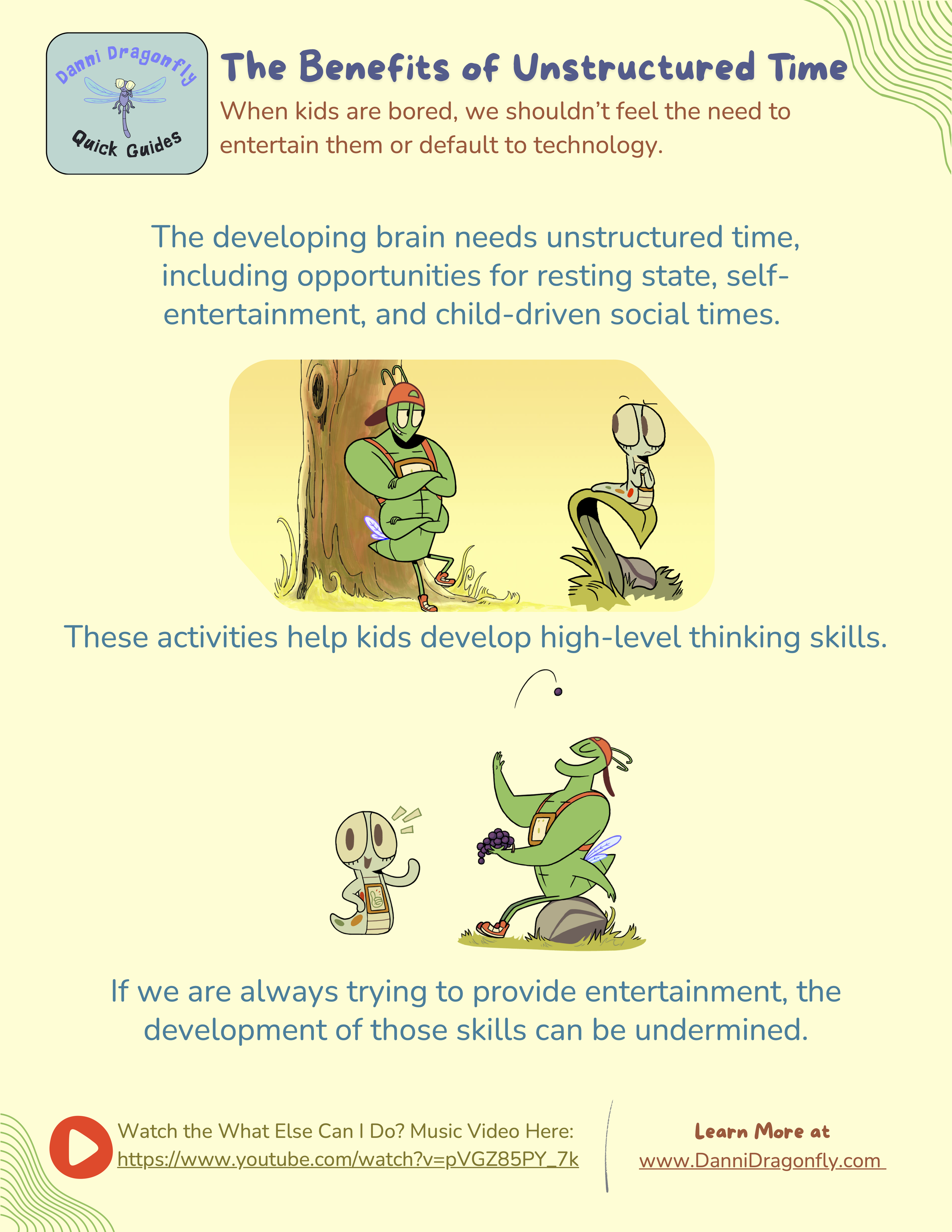
Download the Quick Guide that goes along with this article.
